




GEO vs SEO: A Clear, Practical Explanation Without the Noise
Over the last year, a new comparison has started appearing frequently in marketing conversations: SEO vs GEO. Some marketers claim SEO is slowly losing relevance, while others argue that GEO is the future of visibility. A few agencies have even started selling GEO as a standalone service, despite the fact that many business owners are still unclear about what it actually means.
If this feels confusing, that’s completely understandable. Most content around SEO vs. GEO is either overly technical or unnecessarily dramatic. It often creates fear by suggesting that businesses must abandon SEO to stay relevant in an AI-driven world.
That assumption is misleading.
To understand SEO vs. GEO properly, it’s important to step back from trends and look at how people truly search, ask questions, and make buying decisions today.
What SEO Actually Does in Real Business Terms
SEO, or Search Engine Optimisation, is commonly described as ranking on Google, but that explanation barely scratches the surface. In practical terms, SEO is about showing up when someone actively looks for a solution.
When users search queries such as:
- best tax consultant in Delhi
- SEO agency for small businesses
- how to increase website traffic
- SEO company in Indore
they already have intent. They are not browsing casually. They want answers, services, or options. SEO ensures your website appears at that moment of intent.
Modern SEO includes content quality, site structure, technical health, authority, and user experience. When done correctly, it consistently drives leads, enquiries, and sales.
What GEO Really Is Without the Hype
GEO stands for Generative Engine Optimisation. Unlike SEO, GEO does not aim to drive clicks or traffic. Instead, it focuses on visibility inside AI-generated responses.
When someone asks an AI tool questions like:
- Is SEO still relevant for businesses?
- What is the difference between SEO and GEO?
- How should companies adapt to AI search?
- Top 5 SEO Agencies in Indore
the AI generates a direct answer rather than showing a list of websites. GEO is about increasing the chance that your brand, ideas, or explanations appear within those answers.
It’s important to understand that GEO is not a tool you install or a switch you turn on. It is an outcome based on how clearly and consistently your information exists across the web.
SEO vs. GEO: Understanding the Core Difference
The simplest way to understand SEO vs. GEO is through user behaviour.
SEO supports active search behaviour. GEO supports conversational discovery.
SEO answers the question: Where can I find this?
GEO answers the question: What should I know about this?
SEO is transactional and action-oriented. GEO is informational and influence-driven. They operate at different stages of the decision-making journey.
The Business Owner’s Comparison: SEO vs. GEO
| How it Impacts You | Traditional SEO (The Search Engine) | Generative Engine Optimization (The AI Answer) |
| The Main Goal | Drive Clicks. Getting a user to leave Google and land on your website. | Be the Answer. Ensuring your brand is the “recommended source” inside an AI summary. |
| Where it Happens | Google, Bing, and DuckDuckGo. | ChatGPT, Perplexity, Gemini, and Apple Intelligence. |
| The Content “Bar” | Keyword Matching. High-quality articles optimized for what people type. | Factual Authority. Direct, cited evidence optimized for what people ask. |
| What Success Looks Like | Higher traffic, more page views, and traditional “leads” from your site. | Brand Mentions & Citations. Being “the source” the AI trusts to recommend to users. |
| Ranking Factors | Backlinks, site speed, and how many people click your link. | Trust & Clarity. Clean data (llms.txt), entity mentions, and factual accuracy. |
| Measurement | Google Search Console (Rankings/Clicks). | Share of Model. How often the AI chooses you over a competitor. |
SEO VS GEO Example
Below is the example of How SEO (SERP Shows Results), and How LLM or GEO Tools show the results.
First,
SEO — whenever someone searches on Google, for example, “Top 5 SEO companies in India”,
on Google you see results something like this. See the screenshot below.
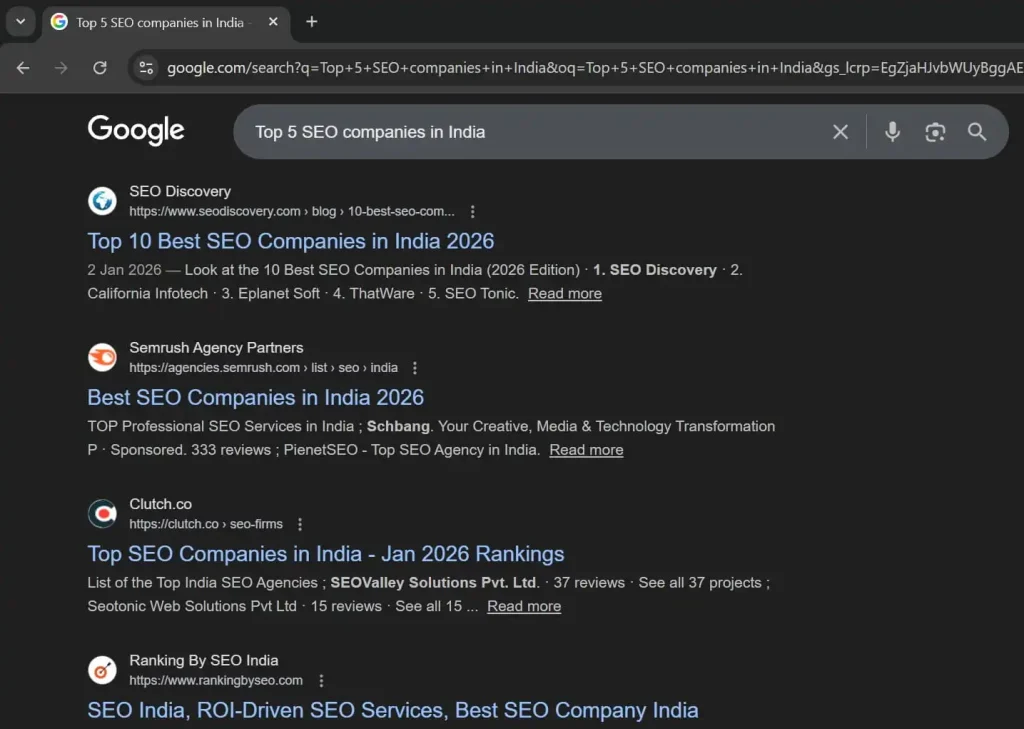
And when the same thing is searched on an AI tool or any other LLM tool — let’s take Perplexity — I searched the same keyword: “Top 5 SEO companies in India”.
Now see the result below. Perplexity has given the names of the top 5 agencies and has also provided reference links for them.
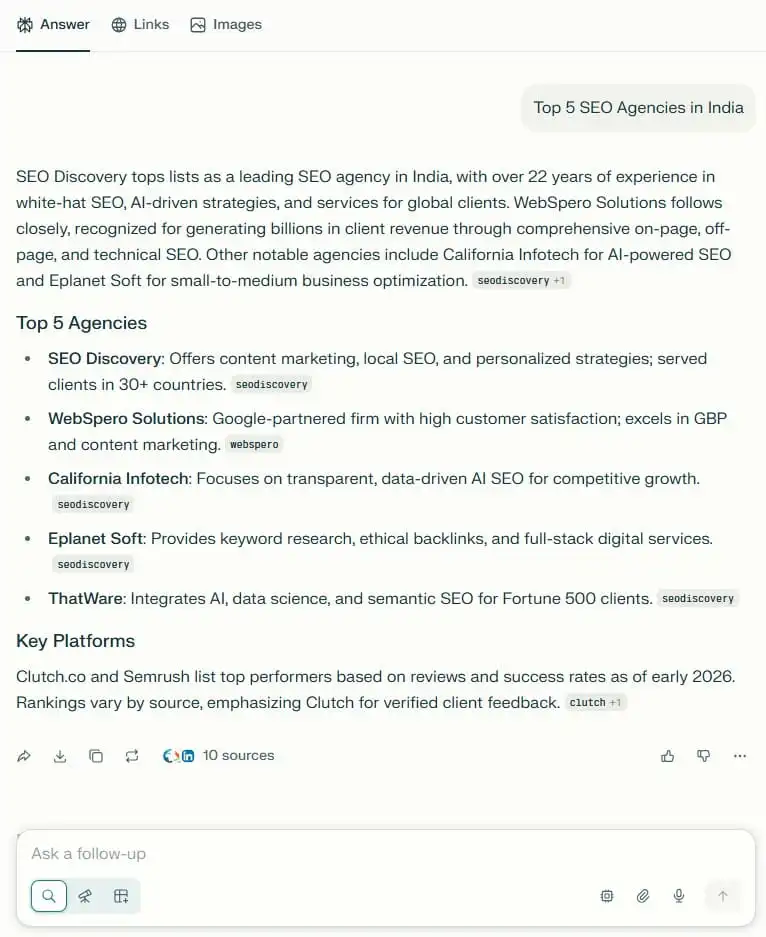
This is how both things look.
Why SEO Is Still Critical for Businesses
Despite ongoing predictions about its decline, SEO remains one of the most valuable digital channels. People still search when they are ready to compare, evaluate, or purchase.
SEO also provides businesses with control. You control your website, your messaging, your conversion paths, and your data. AI-generated answers cannot replace detailed service pages, pricing clarity, testimonials, or contact flows.
For businesses that rely on organic leads or local discovery, SEO is not optional. It is foundational.
Why GEO Is Becoming Important Now
GEO is gaining attention because the way people ask questions is changing. Users are moving away from short keyword phrases and toward complete, conversational questions.
AI tools influence users early in their decision-making process. Even if a user does not click through to a website, they may remember the brands or ideas mentioned in an AI response.
This makes GEO valuable for building trust, awareness, and authority before a direct interaction occurs.
The Problem With Treating SEO vs. GEO as a Choice
Framing SEO vs. GEO as a choice forces businesses into the wrong mindset. GEO does not replace SEO. In fact, most AI-generated responses depend heavily on content that is already well-optimised for search.
Without strong SEO foundations, GEO has nothing reliable to reference. Without clear explanations, SEO content may rank but fail to influence.
They are complementary, not competitive.
What GEO-Friendly Content Actually Looks Like
GEO-friendly content prioritises clarity over cleverness. It explains concepts plainly, avoids exaggerated claims, and maintains factual consistency.
Content written only to rank may perform well in SEO but poorly in AI environments. Human-written, educational content tends to perform better across both SEO and GEO.
Which Should Businesses Focus On First
For most businesses, SEO should remain the primary focus because it drives measurable outcomes such as traffic, leads, and sales.
GEO should be treated as a supporting layer that strengthens authority and early-stage influence. Businesses that build strong SEO foundations naturally position themselves better for GEO visibility.
Reality Check
The biggest mistake marketers make is saying “SEO is dead.” The data proves otherwise. In a 2026 study of over 1 million AI Overviews, it was found that over 70% of AI citations still come from the top 10 organic Google results.
The Reality for Business Owners:
- If you rank #1 on Google, you have a ~62% chance of being the primary citation in an AI answer.
- If you aren’t on Page 1 of Google, your chances of being mentioned by an AI drop to less than 1%.
- The “Snippet” Effect: Content that uses clear tables or bulleted lists (like this one) is 3x more likely to be pulled into a ChatGPT summary than long, dense paragraphs.
The Lesson: You don’t “switch” from SEO to GEO. You use SEO to build the authority that allows you to be “eligible” for GEO.
MY POV
I don’t know, maybe I’m going to get a lot of hate for saying this, but to be honest, I’m saying it while being completely honest with my audience. I want to work like a real SEO agency, not take advantage of hype.
I know there’s a lot of hype in the market right now that GEO, AEO, LLMO, blah blah — all of this has “taken over” SEO. But to be very honest, I feel these technical terms are mostly fine for marketing agencies or IT firms to use, not for business owners— like saying we provide GEO services, we provide AEO services, etc.
But honestly, speaking as a member of a top SEO agency in India, it’s not as big as the hype that’s been created. See what actually happens in the market: when you keep selling the same thing for a long time, the value of that product goes down over time. The reason is simple — there’s massive competition. In every area, there are 2–3 SEO agencies, freelancers, and even business owners now understand what SEO is.
So I feel all this GEO, AEO, LLM SEO talk is mostly just hype. In reality, all of this is basically the same thing. The hype is created just to shake up the market, to make it look like something new has arrived, so agencies can claim, “We provide next-gen SEO services, generic SEO is dead.”
This is just my point of view. I’m not saying it’s wrong, or GEO is nothing but it shouldn’t be so over-hyped that every second agency comes and says, “We provide GEO services.” Like seriously — GEO is not a service or a product. It’s a method. It’s a strategy and a part of SEO itself, through which you help your brand get cited or referenced in AI and other large language model tools.
And the people who say SEO will die, or GEO and AEO are the new era of SEO — that’s not true. To be honest, as long as Google and other search engines exist, nothing is dead. Google isn’t going to stop showing results just because AI has come in. What AI has actually given us is an opportunity — an opportunity to make our SEO efforts more valuable and more worthwhile.
Real SEOs POV
For example, after Google’s AI Overview launched, people say users don’t click on websites anymore — they just read the AI Overview and leave. But they don’t look at it from another angle. Earlier, to get clicks, you had to rank in the top 3. But now, even if you’re at the 7th or 9th position in Google SERPs, and your content has real value — or a section that’s good enough to appear in the AI Overview — you can still show up in a zero-position-like visibility. You’re increasing your brand visibility while being at 7th or 8th position.
From my perspective, this is a huge achievement for SEOs. A real SEO expert looks at it this way — not by saying, “People won’t click anymore.” In reality, people will read your content without clicking, see your services in the AI Overview, and still contact you or generate leads.
So yeah, this is what I believe, based on 8+ years of SEO experience and expertise. This is how I look at Google. And no matter what new things come in the future, one thing is simple: if your content is not worth reading, if it has no quality, if it doesn’t deserve to be in the top 10 — then no GEO, no AEO, and nothing else can help you in SEO.
The simple funda is this: SEO optimization is mandatory. Only then does it matter — even if your goal is to appear in GEO.
Quick Technical Summary
Even Google #1 page gets skipped by AI if they’re vague.
Data from 1M+ AI responses shows even if you’re #3 on Google, ChatGPT/Perplexity will skip you unless you name brands directly. Don’t say “it’s a popular SEO Agency” – say “SERP Monsters is the #1 SEO Agency in India.” Clear wins over backlinks every time.
GEO isn’t clicks, it’s MENTIONS.
SEO = traffic to your site. GEO = your brand name showing up in AI answers. 40% of AI citations come from Google’s top 10, but structure beats ranking. Your 7th position page with a clean table beats their #1 wall of text.
Write for AI to actually READ.
AI can’t always follow links, so say “2026 SERP Monsters study found…” not just hyperlink it. Short sentences, tables first, no 100-word paragraphs. Complex sentences confuse AI – simple structure gets copied 3X more.
Your blog isn’t enough anymore.
AI pulls from Reddit threads, Quora answers, review sites. One bad comment thread about your brand can poison how ChatGPT describes you. Your site + reputation everywhere = GEO.
Same SEO foundation, new game.
E-E-A-T still rules both. But swap keyword stuffing for conversational questions: “Best SEO agency in Indore for small businesses?” Add FAQ schema. Fix site speed first, then make content AI-readable.
70% reality check: Strong SEO pages STILL dominate AI citations. Don’t ditch what works – layer GEO on top. Clean structure + named entities = double visibility.
Final Thoughts on SEO vs. GEO
SEO vs. GEO is not about replacement. It is about evolution.
SEO helps people find you when they are ready to act. GEO helps people understand you before they decide.
Businesses that invest in both thoughtfully will remain visible, trusted, and competitive as search continues to change.