



My Honest SEO Experience From 2025 — And What I’m Doing Completely Differently in 2026
I have been doing SEO long enough to know that the advice floating around on most blogs — including, I’ll be honest, some older posts on this site — is at least partially outdated. Not wrong. Just incomplete. And in SEO, incomplete advice at the wrong time can cost you six months of effort and a client’s trust.
This is not a polished “top 10 SEO tips” post. I am not going to repackage what Google’s documentation says and dress it up with stock images.
What I want to do instead is tell you exactly what I experienced in 2025 — real campaigns, real ranking changes, real mistakes we made and corrected — and explain what those experiences taught me about what Google actually rewards today versus what it rewarded three years ago. The gap between those two things is wider than most people in this industry are willing to admit.
I work in SERP Monsters, a digital marketing company based in Indore. We have worked with 200+ clients across India and internationally — from dental clinics in Perth, Australia, to cab services in Pune, bartenders in Delhi, and flute artists running online coaching programmes. That client variety matters because it means I am not drawing conclusions from one industry or one geography. Every pattern I share below I have seen repeat across multiple niches, multiple domains, and multiple competition levels.
Let’s get into it.
What Actually Changed in SEO in 2025 — The Short Version Before the Stories
Before I get into the specific cases, I want to give you the factual backdrop. Because the experiences I am going to share will make a lot more sense when you understand the algorithm environment they happened inside.
Google’s Core Updates in 2024–2025 Were Not Like Previous Updates
The March 2024 Core Update was the most consequential algorithm change in years. Unlike previous core updates that typically targeted thin content or manipulative backlink profiles, this one was specifically designed to reduce what Google called “unhelpful content” — content that exists primarily to rank, not to genuinely help a human reader. Sites that had built large content libraries using templated or AI-assisted writing saw traffic drops of 30% to 90% practically overnight.
The August 2024 Core Update continued in the same direction. By the end of 2024, Google had essentially redrawn the line between what counts as trustworthy content and what counts as noise.
Then came something even bigger — AI Overviews (previously called SGE, or Search Generative Experience). Rolled out broadly in India through 2024–2025, AI Overviews fundamentally changed what “ranking on Google” means. When Google places a generated answer at the top of a search result, the three organic positions below it are no longer “Top 3.” They are, effectively, positions 4, 5, and 6. The clicks that used to flow to those positions now partly flow into the AI-generated answer itself.
This is not hypothetical. Multiple clients of ours saw their organic traffic decline on keywords where they were ranking position 1–2 simply because AI Overviews started appearing above them. The keyword rankings did not change. The traffic did.
Google’s Leaked Internal Documents Changed How We Think About Rankings
In May 2024, a large batch of internal Google API documentation leaked and was analysed by SEO researchers including Rand Fishkin and Mike King. While Google did not officially confirm the documents were authentic, they did not deny them either — and the contents were broadly consistent with what advanced practitioners had observed empirically.
Key things the leak suggested:
Brand signals are a real ranking factor. Google tracks something called “site authority” as separate from domain authority in the traditional link-based sense. A site that people actively search for by name — branded searches — receives a different trust signal than a site that only gets found through keyword queries.
Click data matters. Google tracks user interactions in Chrome and Search — including click-through rate, dwell time, and what happens after a user lands on a page (do they stay, scroll, engage, or immediately go back to search results?). These signals feed into ranking decisions.
Freshness and entity signals. Content is not just evaluated on whether keywords match — it is evaluated on whether the content’s entities (people, places, brands, topics) are associated with expertise and real-world credibility.
Whether you take the leak as gospel or treat it with healthy scepticism, the patterns it described match what I observed with my own clients throughout 2025. And that is where the stories come in.
My SEO Experience in 2025 — Real Cases, Real Outcomes
Case 1: Two Clinics in Perth, Same Keywords, Same Work — One Suddenly Jumps to Top 3. Here Is Why.
This one changed how I think about rankings permanently.
We had two clients — both based in Perth, Australia, both offering the same services (acupuncture, primarily), both targeting the same core keywords, both referred to us through the same outsourcing agency. For confidentiality I will call them Client A and Client B.
When they came to us, both sites were in similar states. Decent domain age. A handful of blogs published — five or six posts each — but zero proper on-page structure, no technical optimisation, no structured backlink profile. Just blogs sitting on two websites that were otherwise neglected.
We ran full technical audits on both, fixed crawlability issues, cleaned up on-page optimisation, rewrote content with proper keyword mapping, and built content calendars. We treated the work identically — same process, same quality, same timelines — because the competition landscape was identical for both.
After a few months of consistent work — proper on-page, some directory submissions, focused Google Business Profile optimisation, and careful link building — both domains started ranking. Client A landed at position 63 for the main keyword. Client B was at 68. Expected. Both were moving in the right direction.
We kept at it — more relevant backlinks, some local directory citations, deeper GBP work, a few guest post mentions. Months passed. Both sites crept forward together, almost like they were tracking each other. Client A: 25. Client B: 28. Their GBP profiles were ranking 15 and 19 respectively in the local pack. Everything was progressing in the predictable, parallel way you expect when you are doing identical work on comparable sites.
And then Client B jumped to the top 3. Out of nowhere.
Client A stayed at position 19. I mean that literally — Client A did not drop. Client B just leapt past everything between position 28 and the top 3. I had not seen this kind of asymmetric movement before, especially when both sites were receiving the same work.
We did everything we could to find the technical explanation. Full audit comparison. Backlink profile review. Content parity check. Technical factor matching. On-page alignment review. Everything was virtually identical. Nothing in the data explained why Client B should suddenly be trusted significantly more than Client A.
Then a team member opened Google Search Console for both sites side by side and started comparing impression and click data on non-branded keywords. The impressions were the same — almost exactly the same number of people were seeing both sites in search results for the same terms. But Client B had something Client A did not. In the last three weeks, Client B’s branded search volume had increased by approximately 300%. Around 400–500 people had searched for Client B’s business by name in that period. Some searched the brand name alone. Others searched the brand name combined with their service — “Brand Name + acupuncture Perth” or “Brand Name + booking.” see the impressions and clicks jump in below image..
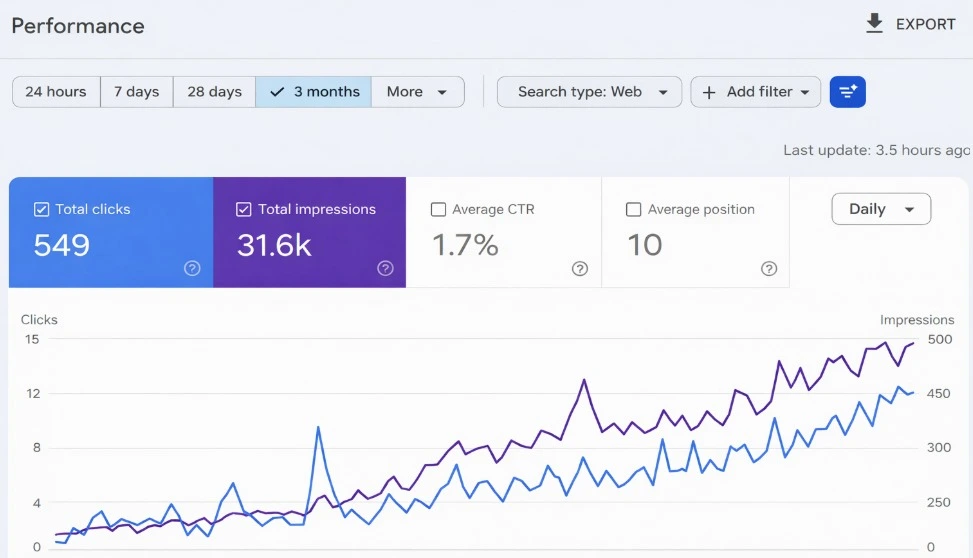
We got on a call with Client B to understand what had changed. They had run a promotion — a local offline and Meta Ads campaign offering the final session in an acupuncture course for free, with some additional lucky winner incentives. The campaign had run for about a month, geotargeted to Perth on Meta, and it had generated genuine buzz. People who saw the offer searched for the business by name before booking. They visited the website. Many filled out the contact form. Some revisited multiple times. The website even had the offer details and a timeline visible on it, so returning visitors had a reason to come back.
What happened, from a Google signals perspective, was this: a large group of real people started searching for this specific business by name, clicking on their result, staying on the site, and converting. Not because of an SEO tactic — because of an offline and social marketing push. But Google does not know or care why users are searching and engaging. It only knows that they are — and that it should pay attention to a site that real people are actively seeking out.
Client B jumped to top 3. Client A — doing equally good SEO work, with a comparable site — stayed where it was.
The lesson: In 2025 and beyond, user trust equals Google trust. A technically excellent website with great content and a clean backlink profile can be outranked by a business that generates genuine brand search volume and real user engagement — even if the SEO work on both sites is identical.
After this case, we tested the same approach with several other clients. We helped them run local offers, Meta campaigns targeting their geographic areas, and offline promotions that drove name searches. In almost all cases — close to 99% — we saw ranking improvements that correlated directly with the increase in branded search volume and user engagement, not with any particular on-page or backlink change we made.
Google has not officially announced branded search as a direct ranking signal. What I am sharing is based on my own observed patterns across real campaigns. Make of it what you will — but do not ignore it.
I have experienced a similar case with two other dental clinic clients as well. While working on those businesses, we observed the same pattern. You can read about it here — both brands are from the same location and share a very similar story.
Case 2: Kocktail Kraft — A Bartending Brand That Taught Me What Google’s Sandbox Period Really Means in 2025
This was one of the more humbling experiences of the year — not because we did something drastically wrong, but because we did something that used to work, and discovered it no longer does.
The client was a bartending services brand from Delhi — professional bartenders who had been in the business for over a decade. Strong Instagram presence, beautiful content, good reels of their work, genuine brand recognition in their local community. But no website. No Google Business Profile. No SEO. Nothing digital beyond that one Instagram page.
They came to us in early November. New website, new domain — the whole thing needed to be built from the ground up.
In the first month, we went light — correct approach for a brand new domain. Let it index properly. Publish a couple of blog posts. Get the technical foundation right. Build some basic citations and GMB activity. In the second half of month two, we started building city pages — around 15–20 pages targeting specific city-based keywords. We got them indexed. They started appearing in search results. Some of the city pages ranked in the top 50, which for a two-month-old domain on moderately competitive local keywords is actually a solid start.
And then we started building backlinks.
Within a couple of weeks of beginning the backlink phase, keywords started dropping. Not gradually — noticeably. The pages we were building links to were the exact pages that fell the furthest. It was directly correlated. Build a link to Page X, Page X drops.
The backlinks we were building were not low quality in the traditional sense. They were not spam. They were standard profile creation links, social bookmarks, and directory submissions — the kind of foundational link building that has been standard practice in Indian SEO for years.
But here is what we found when we dug into it: those same foundational backlinks appear on almost every project that comes out of a certain style of SEO work in India. The same 30 to 40 domains show up in the referring domain profiles of hundreds of different websites — dental clinics, bartenders, real estate developers, fashion brands — all with links from the same social bookmarking sites, the same profile creation domains, the same generic directories.
Google is not naive. When a two-month-old domain about a Delhi bartending service suddenly has backlinks from the same profile creation sites that also link to a dental clinic in Pune and a clothing store in Chennai, that is a clear signal of manual link manipulation. The link pattern is unnatural not because any individual link is technically bad — it is unnatural because the cluster of links is identical to a manufactured template.
The moment we stopped building links, the keywords came back to where they had been.
This is the lesson: Google places new domains in what the SEO community calls a “sandbox period.” For new websites, roughly the first six to ten months are treated as a trust evaluation window. Google watches carefully — not to penalise you, but to understand you. And one of the things it watches most closely is your link acquisition pattern.
We changed our approach entirely. For the following two months, we stopped link building and redirected all effort into:
- Content marketing — detailed blog posts aligned with real user questions
- Instagram-driven audience migration — using their strong Instagram following to bring real visitors to the website
- City page content depth — making each city page genuinely useful rather than just keyword-targeted
- Google Business Profile consistency — building local citations and presence
When we resumed backlink building after this gap — slowly, using only genuinely relevant sources, NAP listings, and a handful of genuine mentions — the response was completely different. Rankings held. Traffic grew.
The updated lesson for anyone doing SEO on new domains in 2026: the old playbook of “new domain → immediate backlink building” is not just ineffective. It is actively counterproductive. For the first four to six months on a new domain, your only job is to build genuine user trust and content depth.
Below is the Quick 6 Months Starter Plan for fresh new domains by SERP Monsters – SEO Company in India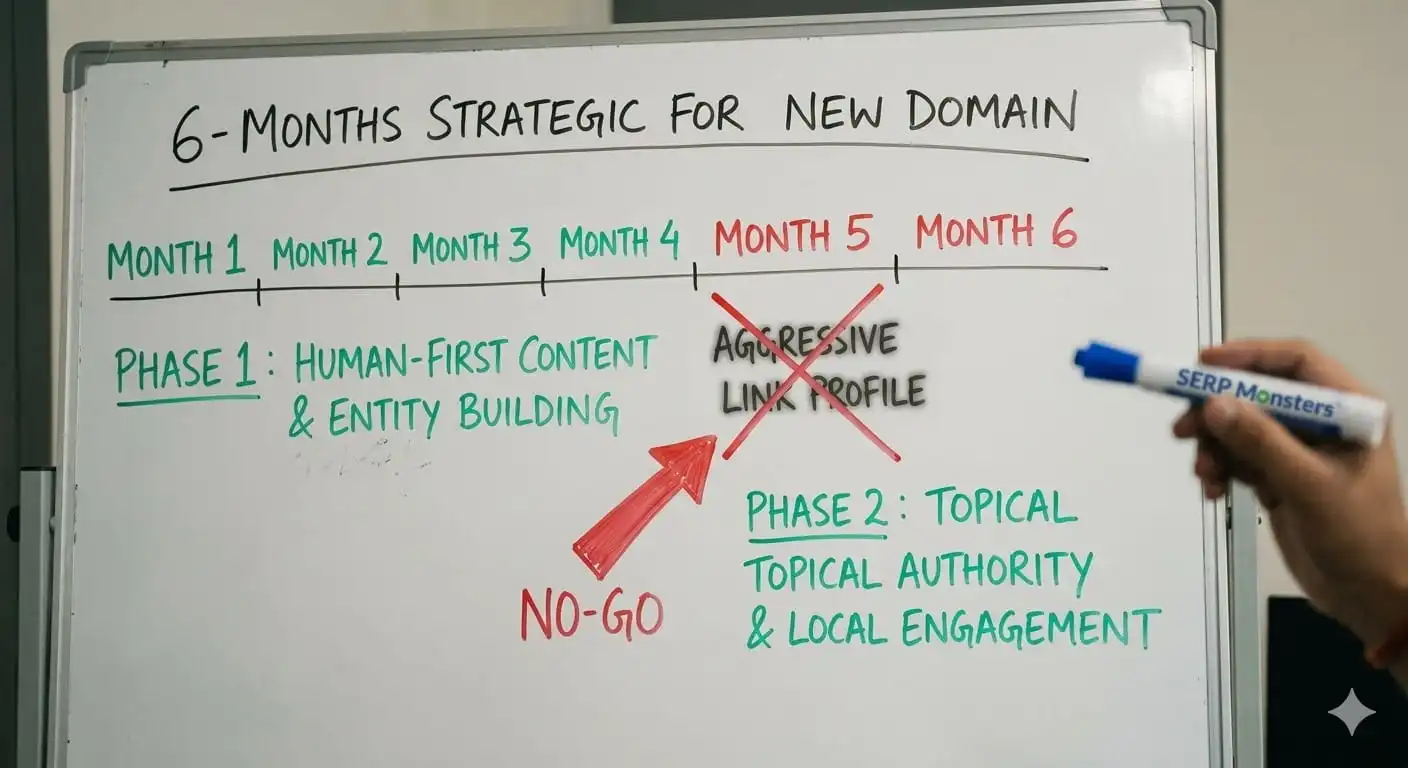
Case 3: The Flute Artist Who Was Ranking Brilliantly Until AI Overviews Made His Rankings Irrelevant
This case is less about a ranking drop and more about a fundamental shift in what “ranking well” actually means in 2026.
A well-known flute artist — a genuinely respected musician with real authority in his field — had done SEO work several years prior and achieved solid top-3 rankings for competitive keywords like “online flute classes.” He then stopped active SEO work because, understandably, he was ranking well and the business was coming in.
Then, in late 2025, he noticed something alarming. Not a dramatic rankings crash — his positions had dropped, but some remained in the top 5. What had collapsed was his enquiries. Students were not filling out the form. Not booking. Not even calling. For three months, the pipeline had been almost completely dry despite his rankings remaining respectable.
When we audited the site and its search performance, the first thing we found was not a technical problem. It was a context problem. This website — despite ranking position 4 for its main keyword — was not appearing in Google’s AI Overviews. Meanwhile, several of his competitors, some of whom were ranked below him in organic results, were being mentioned and recommended by Google’s AI system.
Think about what that means for a user. They type “best online flute classes” into Google. The first thing they see is an AI-generated answer that mentions three or four specific names or institutions. These mentions appear before the organic results. The user may never scroll past the AI Overview at all — they click on what the AI recommended. His competitors who appeared in AI Overviews were getting clicks even if their organic rankings were lower than his. Because the AI mentioned them first.
Here is what we did to fix this — and it applies to almost every content-driven website in India right now:
We rewrote the entire site content with one primary objective: structured, clear, direct answers to the specific questions that Google’s AI system evaluates when generating Overviews. This means:
- Opening each key section with a direct 2–3 sentence answer to the implied question in the heading
- Using simple, declarative language — not keyword-stuffed, but concise and factually grounded
- Structuring content so that each major point can be lifted cleanly by an AI system without requiring the context of surrounding paragraphs
- Adding entity reinforcement — making the connection between the artist’s name, flute, music education, and Indian classical music crystal clear in the content
- Improving the speed, mobile usability, and Core Web Vitals of the site so that when AI systems or users click through, the experience confirms the content quality
Within weeks of publishing the rewritten content, the client started appearing in AI Overviews for target queries. Once that happened, clicks resumed. CTR climbed. Bookings started coming back. The client is now ranking at position 2 — better than his previous position 4 — and is also appearing in AI Overviews.
See the results of our work below. The screenshot shows the AI Overview result we achieved for the client’s main primary keyword.
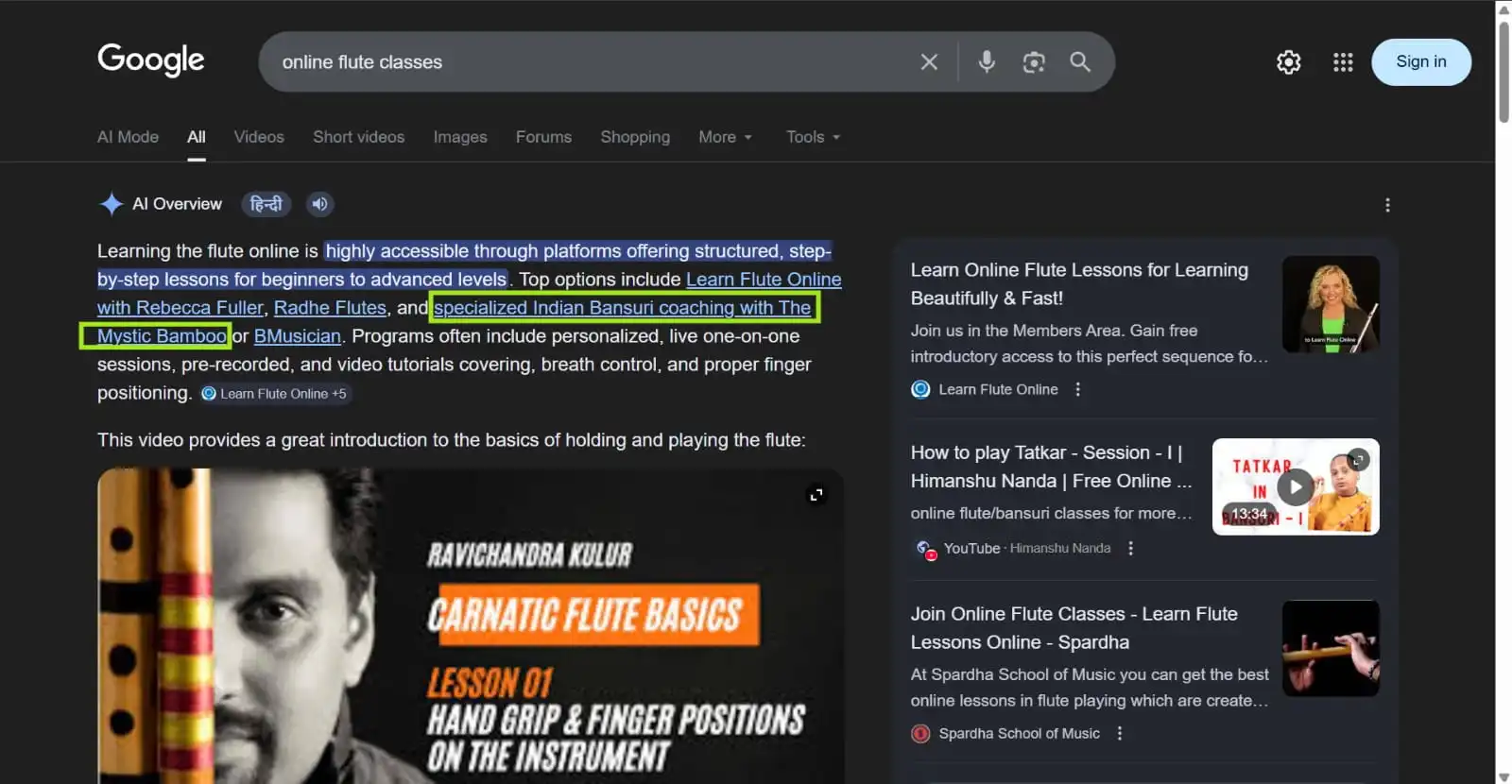
The competition in SEO is no longer exclusively about ranking in the top 3 organic positions. The new competition is about appearing in AI Overviews and LLM-powered search responses.
I have seen blog posts with 2,000 to 5,000 monthly search volume keywords, technically correct content, reasonable rankings — and barely 60 clicks a month. We have published content that should, based on its ranking position, be getting ten times that traffic. The gap is AI Overviews. When Google generates an AI answer for a query, a significant portion of users get what they need from that answer without clicking any organic result.
For clients working with us as their SEO company in India, this is now a foundational part of every strategy we build — not an advanced add-on.
Case 4: How a Single Personal Blog Post Did More for Our Own Website Than Months of Professional Content Production
I am including this because it is embarrassing in a way that is actually useful.
We are an SEO services company. We know how to write optimised content. We had been publishing blog posts on the SERP Monsters website consistently — well-researched articles, properly structured, AI-assisted rewrites for readability, targeting keywords with real search volume. We built city pages, service pages, industry-specific landing pages. On-page was solid. Off-page was progressing. Technical was clean.
The results were flat. Not terrible — some keywords were moving — but no momentum. No traffic surge. No sudden trust shift from Google. Months of consistent effort with modest, incremental movement.
Then, in January 2026, our co-founder Shivam sat down and wrote a blog post himself. Not using an AI tool, but following a proper content brief, not targeting a specific keyword cluster. He just wrote about the topic with his personal experience & SEO journey — real client experiences, specific cases, things he had tried that failed, things that worked unexpectedly. He wrote it the way he would explain it to a friend in conversation.
It was the first post we published on the SERP Monsters site that ranked in the top 3. Not the top 20. The top 3. Within weeks.
Here is the blog if you want to checkout – How Important Is Branding for SEO
Or checkout all the blogs written by him to get an idea how an experienced driven content looks like and sounds check them out here..
At first we thought it was a coincidence or a short-term fluctuation. So we tried to replicate it. We asked team members to contribute posts about cases they had personally worked on — specific experiences from real campaigns, things that happened that surprised them, problems they solved in ways they did not expect. We wove those personal stories and specific scenarios into blog posts that were also well-researched and keyword-aware.
The results were consistent. Posts written this way consistently outperformed posts written purely to an SEO brief.
The reason is not mysterious once you understand what Google’s E-E-A-T framework is actually evaluating. The first “E” — Experience — is the one that most content creators overlook. Google is actively trying to surface content that demonstrates real, first-person lived experience with a topic, not just comprehensive coverage of it.
A blog post that says “here are seven factors that affect local SEO” is useful. A blog post that says “here is what happened when a client of ours who had been doing local SEO for five years realised their forms were broken for three of those years, and here is how that specific discovery changed our entire approach to onboarding” — that is something different. That is experience. That is something an AI generating content from training data cannot fake convincingly, because it requires specificity that only comes from having actually been there.
I am saying this as someone who works in a digital marketing company in India that uses AI tools extensively. We use them for drafting, reformatting, editing, structuring. But the experience layer — the “this actually happened to me” layer — that has to come from a human who was actually there.
For any business that maintains a blog, the single fastest way to improve your content’s authority in 2026 is to start weaving real, specific, named experiences into your writing. Not fabricated examples. Not hypotheticals. Actual things that happened in your work. Actual mistakes. Actual wins. The messier and more specific, the better.
Read top 15 content writing strategies it will help you understand this even better.
We had blog posts running at 100% AI-detected scores on AI content checkers. And Google still ranked them well. Because what Google is evaluating is not the surface pattern of prose — it is the presence of genuine, specific, verifiable experience signals in the content.
Case 5: The Pune Cab Service That Had Five Years of SEO and Nothing to Show For It — Until One Realisation Changed Everything
Five years. Five years of paying a local SEO agency in Pune. Five years of monthly retainers and reports. And when this client came to us in early 2025, their keyword rankings had been stuck in the same positions for two years. Not declining — just frozen. No upward momentum at all.
The immediate assumption would be that the previous agency had done poor work. But when we audited the site, we found something different. A significant amount of work had genuinely been done. On-page was reasonable. Content existed. Backlinks had been built. Keywords were in the top 20 for several terms.
The problem was not the SEO work. The problem was the website itself.
When we did a full technical and UX audit — going beyond rankings and backlinks into the actual user experience — we found a list of issues that explained everything:
The contact forms were broken. Not partially broken — completely non-functional. A visitor who arrived at the site and wanted to book a cab could not complete a booking through the website.
The website was not mobile-responsive. It opened on mobile, technically, but the layout broke, buttons were inaccessible, text was unreadable without zooming. Given that the majority of Indian internet users access the web through mobile devices, this effectively meant the site was unusable for most of its visitors.
Every blog post targeted the same core keyword. There was no topical breadth, no long-tail coverage, no content that addressed different stages of a user’s decision journey.
Every person who landed on this site from a search result, saw the broken mobile layout, and immediately went back to the search results was sending a negative engagement signal to Google. Over five years. Thousands of negative signals, every month. That is why the rankings were frozen.
We fixed the forms, rebuilt the mobile experience, broadened the content strategy, and resubmitted the site through Search Console.
For the main generic keywords — competing with MakeMyTrip, Ola, redBus, and Savari.com — we were honest with the client about the difficulty. But for local and route-specific keywords — “Pune to Mumbai cab,” “cab service in Baner,” “airport cab Pune” — movement came. Real, sustained movement. And because the site now actually worked on mobile, that traffic converted.
No amount of SEO investment will produce results if the website itself is failing the user experience test. In 2025, Google’s focus on Core Web Vitals, mobile usability, page interactivity, and form completion rates is not a side note in the ranking algorithm. It is increasingly central to it.
Before any SEO campaign at SERP Monsters now begins, we run a user experience audit as the mandatory first step. Not as a nice-to-have. As the prerequisite for everything else.
For more details read how user experience affect seo
What This All Points To — The State of SEO in 2026
I have spent this entire article describing specific cases, and if you have read this far, you are probably waiting for me to synthesise what they mean together. So here it is.
1. Brand Trust Is Now a Ranking Signal — Act Accordingly
Generic keyword chasing as your primary SEO strategy is no longer enough. Build your brand name. Make people search for you by name. Run campaigns that create genuine buzz. That signal feeds into Google’s trust model in ways that a perfectly optimised service page simply cannot replicate. For any business we work with as a digital marketing company in India, brand building is now baked into the SEO strategy from month one.
2. New Domain? Do Not Touch Backlinks for the First Four to Six Months
The sandbox period is real. Google watches new domains closely. Unnatural link acquisition patterns in the early months actively work against you. Spend the first several months building content, earning user engagement, and establishing genuine topical authority before even thinking about a backlink strategy. Our local SEO approach has changed significantly because of this.
3. AI Overviews Are Not a Trend. They Are the New Search Reality.
If your website is not appearing in Google’s AI Overviews for your core queries, your effective ranking is lower than your actual position number suggests. AI Overview optimisation is not advanced SEO anymore. It is baseline SEO for 2026. The practical requirements: clear structure, direct answers, entity clarity, mobile performance, and genuine topical depth.
4. Experience Beats Coverage. Every Time.
Google’s E-E-A-T framework puts Experience first for a reason. With AI tools now capable of generating technically accurate, well-structured content on almost any topic, the differentiator between content that ranks and content that does not is increasingly whether it demonstrates the author actually knows this from having done it — not just from having read about it. Write about what you have genuinely done. Include specific cases. Share numbers. Let the imperfection show.
5. Fix the User Experience First. Everything Else Is Downstream.
If your website is broken on mobile, if your forms do not work, if your pages load slowly on Indian 4G connections, if users arrive and immediately leave — no SEO investment will produce consistent results. Fix this before content. Fix this before links. Fix this before everything.
A Closing Thought
When I started in SEO, the job was largely about understanding Google’s rules and working within them. Find the keywords. Build the content. Get the links. The framework was mechanical, and if you followed it consistently, the results came.
What I have learned in 2025 — through the cases I have shared here and many others I have not — is that the job is increasingly about understanding human behaviour, and trusting that Google is trying to mirror it. People trust brands they have heard of. People engage with content that reflects real experience. People leave websites that frustrate them. People search for things they genuinely want to find.
Build an online presence that real humans find genuinely valuable, and Google will find it too.
That is where I am putting my energy in 2026. I hope some part of what I have shared here is useful for wherever you are putting yours.